Artist Spotlight: In the Studio with Alondra Ruiz-Hernández
We sat down with Alondra to discuss the journey, philosophy, and creative process behind her powerful and deeply resonant work.
Jul 18, 2025
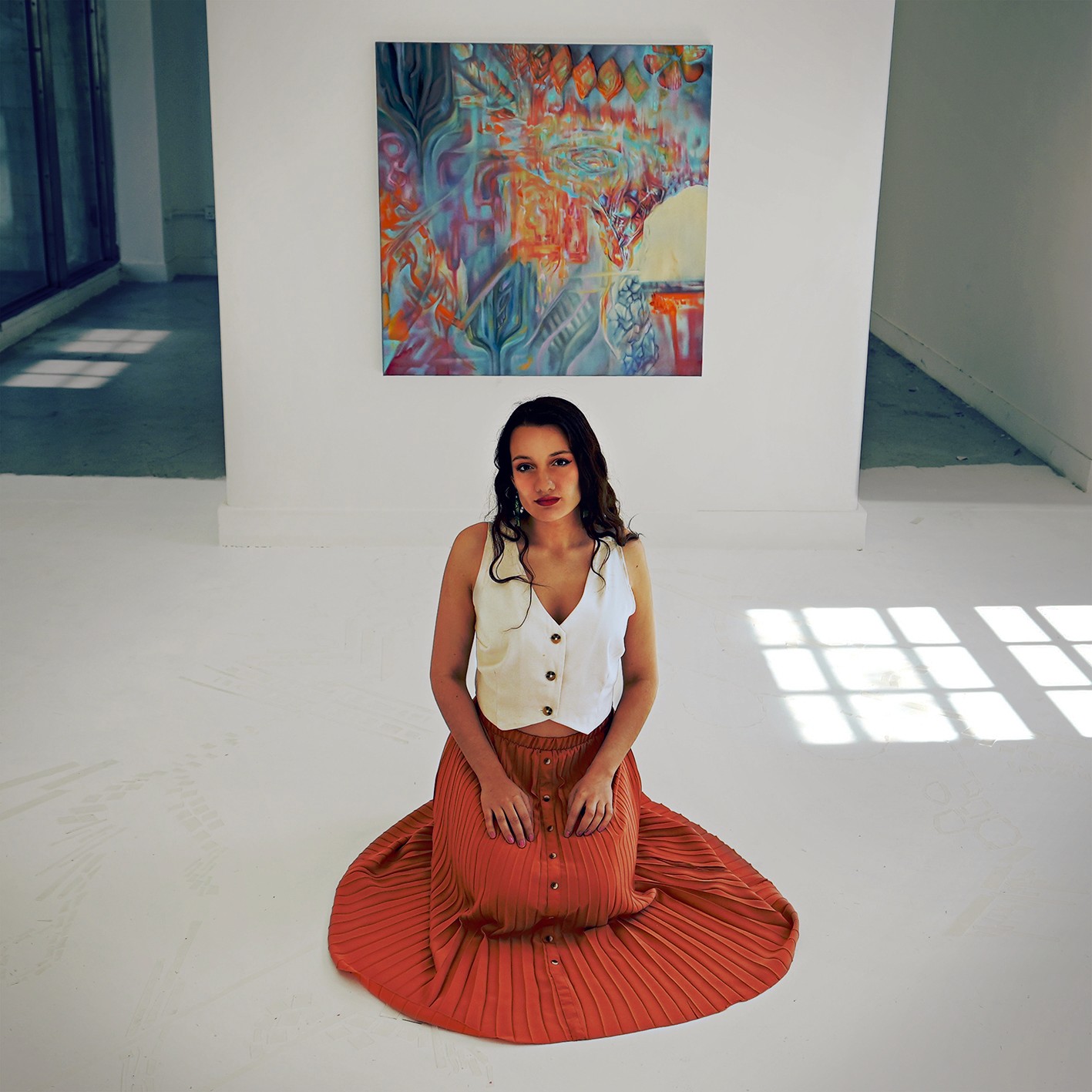
Mexican Canadian artist Alondra Ruiz-Hernández is a creative force whose work defies easy categorisation. A cross-disciplinary artist working across oil painting, photography, textile design, and performance, her practice is a profound exploration of our place in the world. Having showcased her work in over 50 international exhibitions, from the Mexican Embassy in the UK to the Toronto Biennial of Art, Alondra uses her art to ask a fundamental question: how can we contribute to a more equitable and sustainable world? Her work dismantles the illusion that humanity is separate from the environment, weaving together themes of mortality, trauma, and identity to guide us back towards a collective consciousness.
The Spark: An Artist’s Awakening
Gallerfy: Where did your journey as an artist begin?
Alondra: "As a five-year-old, I used to say I was going to grow up to be either a princess or an artist. Well... the princess gig didn’t quite work out, so I went with the artist! I was fortunate to grow up in a very artistic family; My mother, who is an extraordinary artist and art therapist, was my hero and my first teacher. Wanting to learn everything I could from her set me firmly on this path, and it’s a journey I’ve been on ever since."
Gallerfy: You’ve mentioned the importance of mentorship. Was there a particular person who helped shape your artistic direction?
Alondra: "Absolutely. I was fortunate to have an extraordinary high school professor, Matthew Varey, whose influence was pivotal. He challenged his students to move beyond merely replicating the great works of art history – which had been the method of art education I had received in other institutions – and instead urged us to turn inwards, asking ourselves: ‘What do I truly care about?’ “What are my deepest values?’ He didn’t want us to create simply because something had been done before; he engendered us to uncover what was authentic and meaningful to us personally."
That guidance was transformative in shaping my identity as a young artist. It sparked the creation of my ‘Connections’ series, where I photographed my friends and integrated natural forms around their images to explore the idea of our fundamental interconnectedness. At first, these works were modest in scale; simple sketches and small prints. But then my professor posed a question that stayed with me: ‘What is limiting you from working on a monumental scale?’ Inspired by that challenge, I began printing the photographs life-size and working into them directly. Those large-scale pieces went on to win awards in New York, a milestone that gave me the confidence to see myself not just as a student experimenting with ideas, but as a true artist and to question my own preconceived limitations I had been unconsciously placing on myself."
The Philosophy: Art for a Collective Consciousness
Gallerfy: That professor encouraged you to find your values. What are the core values that drive your practice today?
Alondra: “My deepest value as an artist lies in continually asking: How can I use my voice and skills to foster a deeper reverence for vulnerability and to temper hubris? I care deeply about a collective consciousness and the well-being not only of myself but of how I choose to interact with the world. It’s about aligning your values with your existence.
Art, I believe, lives in a space of ambiguity. It does not seek to provide definitive answers but to invite deeper questions. In a world obsessed with certainty and facts, there is a quiet wisdom in learning to sit with the unknown; an openness that allows transformation, both personal and collective, to take root.”
“My deepest value as an artist lies in continually asking: How can I use my voice and the skills to foster a deeper reverence for vulnerability and to temper hubris?”
Gallerfy: You speak about a “traumatized collective consciousness.” Can you expand on that and how it relates to crises like climate change?
Alondra: "I was influenced by the philosopher Marshall McLuhan, who described the world as a 'global village'; an interconnected network functioning much like a brain or nervous system. And if we accept that analogy, then it follows that this collective brain can also experience trauma. From this perspective, I theorize that many of the crises we face today, e.g. the climate emergency, the migrant crisis, etc., are not isolated events but symptoms of a traumatised collective consciousness. From what I have learnt, observed, and read, I would argue that this trauma stems from a culture that doesn’t nurture vulnerability, care, or collective well-being. Instead, we see society responding much like an individual in distress, through patterns of fight, flight, or freeze. Some people become combative and polarised, others retreat into denial or utopian fantasies of the future, and many even feel paralysis in the face of urgent problems.
So, if that’s how I feel, then I’m faced with a difficult but essential question: How can I, as an artist, offer a perspective that interrupts this ongoing cycle? Even if my work only reaches one person, someone who engages with it for just a short period, that moment matters.
If a viewer stands before one of my pieces and feels even the slightest shift – if they glimpse the world, or themselves, through a different lens – then that small rupture in their usual patterns of thought can be profoundly meaningful. Change doesn’t always come in sweeping revolutions; sometimes it begins quietly, in those subtle moments of recognition and reorientation. I believe those moments are worth striving for.
This thread of thinking led to a series of paintings named ‘Collective Psyche’. In these works, through creating ruptures, whether painted or physically torn and/or burned, I give form to the deep wounds of our global village.They function as layers or veils, screens behind screens, through which deeper truths are glimpsed.
The word vulnerability is derived from the Latin vulnus (meaning ‘wound’), which is central to my work: ruptures are not only signs of destruction but openings into our unhealed collective consciousness. As poet David Whyte writes, to be vulnerable is to be “open to the world whether you like it or not” This openness, especially in the face of discomfort, is what invites the possibility of transformation."
The Craft: A Meditative Process
Gallerfy: With such profound themes, how can engaging with art help on a practical level?
Alondra: "I have always found viewing art as a meditative process. When you step into a gallery, you enter into a silent dialogue with the artwork and the artist. A dialogue that transcends language, space, and even time. Through a single piece, you can converse not only with the present moment but with artists across centuries, bridging eras through a shared human experience.
In times of trauma or upheaval, our instinct is often to react, to leap into action. But stillness can be just as vital. It creates the space for wisdom to emerge, guiding us toward more thoughtful and meaningful action. ‘Just doing’ is not always the best approach. Art offers that space. It invites us to pause, to let our thoughts settle and dissipate, and to encounter parts of ourselves we might otherwise overlook. In this quiet exchange, art can nurture a deeper awareness, opening the door to responses that are not just reactive, but allow us to choose wise action."
“I think that a lot of artists... have this innate desire that they need to create because it's a way of understanding the world around them.”
Gallerfy: You often feature your own body in your work. Once a piece is finished, how do you feel about it being interpreted in ways you may not have intended?
Alondra: "One of the most intriguing aspects of being an artist is this moment of release. You begin with countless ideas swirling within you, and then, as the piece takes shape, there comes a point when it suddenly feels complete. In that moment, it no longer belongs entirely to you, it exists on its own, independent of the artist.
Once the piece is out in the world, people form their own relationships with it, sometimes in ways completely different from what you intended. That’s part of the beauty of it: you have to let it go – again why art making and viewing reminds me of a meditative practice. Some people will love it, some will hate it, and you have to be comfortable with that. Even when a piece provokes aversion, it still holds power, because it stirs something within the viewer. It compels them to ask why they feel that way, and in that questioning, the work continues to live and to transform.
I sometimes imagine the work and myself as two separate entities engaged in an ongoing conversation. My role is to listen carefully, to discern what the piece is asking for next. We move together in this dance, entwined in a shared process of becoming. And when the dance is done, we both part ways, the work and I go out into the world separately."
The Journey: Navigating the Art World
Gallerfy: You’ve achieved so much, from international awards to organising a major retrospective for the artist John Golding. What’s been your biggest challenge?
Alondra: "The art world is a constant struggle. After completing my master’s degree (and no longer having the support of student scholarships), the reality hit hard. I needed to pay rent but opportunities were scarce, so I began reaching out to artists directly, offering my skills as an assistant. Hard work is inevitable, but very few artists enter it for the money. If that were the goal, we would have chosen entirely different professions. We all step into this knowing there’s no clear or predictable route forward.
What I’ve learned is that kindness is one of the most powerful tools you can carry. While assisting once, I made coffee for a woman who was collecting paintings and took a genuine interest in her journey. Only later did I learn that she, Christine Hourde, was the director of a major institution. Had I known at the time, I might have been too nervous, but because I approached her simply with curiosity and respect, it created a genuine connection. I had the privilege of listening to her stories, and she, with generosity, listened to me, my thoughts, my history and relationship to art. Christine, being a remarkably kind person, not only viewed my portfolio and offered her thoughts, she also introduced me to key figures in the art world, including Paul Zuckerman, Chair of the John Golding Artistic Trust.
Inspired by John Golding’s paintings (which are profoundly influenced by Mexican muralist José Clemente Orozco, whose murals I grew up seeing in Mexico as well) I immersed myself in his life and legacy. My collaboration with Paul Zuckerman evolved into a project where I met with directors of major museums in Mexico City, developing the historical and curatorial framework that ultimately secured approval for a comprehensive retrospective of Golding’s career. This allowed me to work closely with the Museo de Arte Moderno, one of Latin America’s most important museums, as our host venue.
The project also led to a partnership with Messums ORG, where I had the opportunity of learning directly from Johnny Messum, a leader known for creating innovative art spaces and fostering meaningful dialogue between artists and audiences. Through all of this, I served as Lead Exhibition Coordinator and became Messums ORG Art Representative in the Americas. I directed the logistics for a retrospective of over 200 works, collaborated with brilliant historians such as Dawn Ades, Brenda Caro, and Jenna Lundin, and translated the entire bilingual exhibition catalogue to ensure accessibility in both English and Spanish.
And to think, it all began with making a simple cup of coffee and listening to someone’s story. Of course, years of hard work and education were essential, but that small act set in motion opportunities that transformed my career.
Gallerfy: Of all your achievements, what are you most proud of?
Alondra: "Well, I could list out my CV for you and talk about the awards or the museums I’ve exhibited at. However, I feel it is important to say that I’ve had a very intense life, with incredible highs like studying abroad, and profound lows. By the age of 23, I had already lost four friends, two who unalived themselves, and that kind of loss brings a very particular kind of grief. Those experiences drew me toward exploring trauma: how to heal myself, but also how to use my voice so that others might feel less alone and more connected. Out of that, I’ve managed to carve a life that feels more balanced, and that balance allows me to remain vulnerable, to keep listening, and to keep creating. Of course, it’s an ongoing learning process.
For me, there’s a quiet resistance in valuing that; It’s living in a way that honours vulnerability, and using my work as a vehicle for understanding. If my art helps even one person feel less isolated or more open to their own transformation, then that, to me, is something worth being proud of."
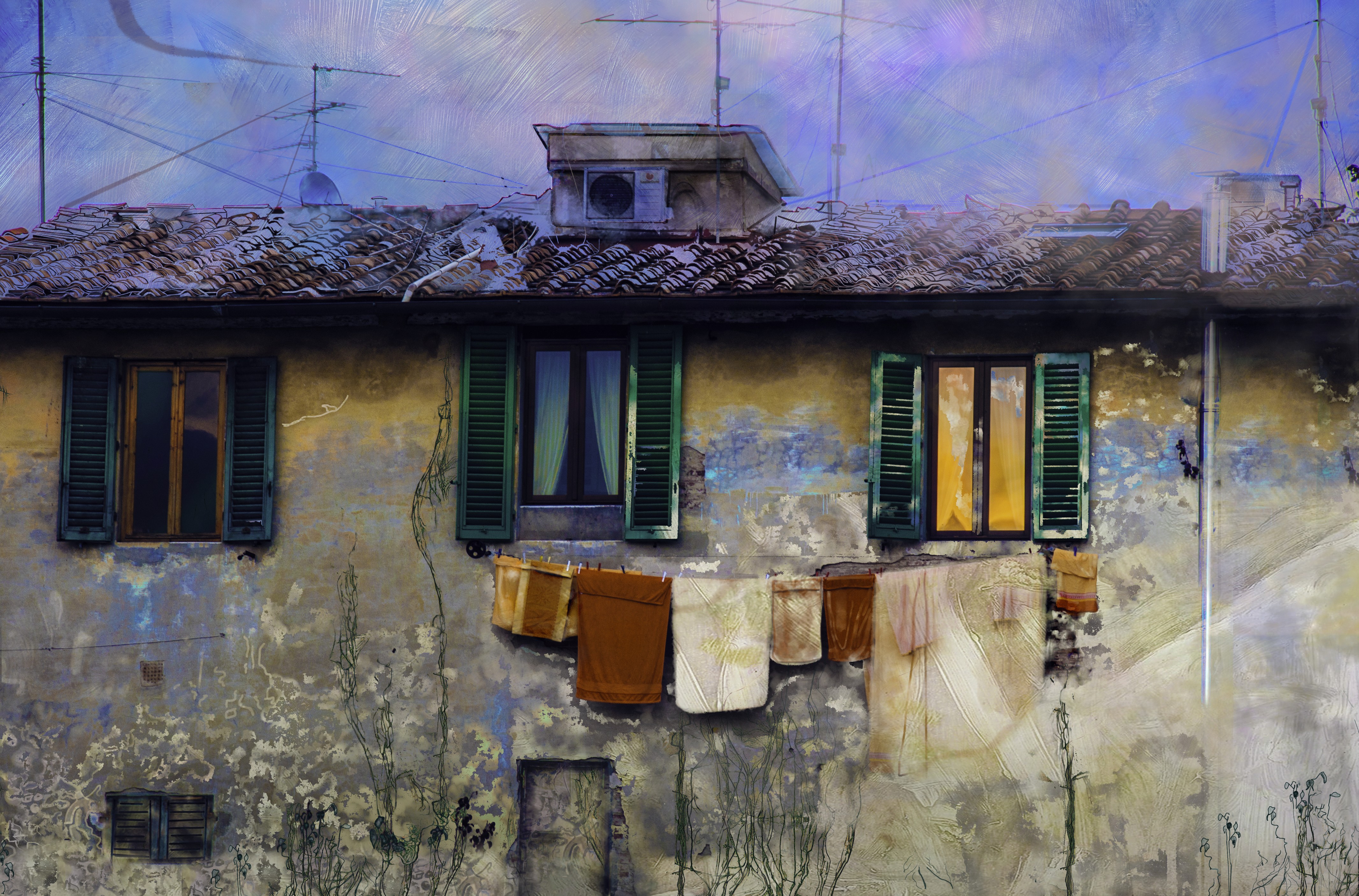
'Elegy of Erosion' - Copyright © Alondra Ruiz-Hernández. All rights reserved.
Alondra's work is a testament to the power of art to not only reflect the world but to actively shape it. By transforming personal and collective wounds into stunning visual narratives, she invites us into a space of contemplation, connection, and ultimately, healing.
To explore more of Alondra’s work, visit her profile on Gallerfy.